For ADHD Entrepreneur Productivity – try a small, reliable habit tonight: spend 15 minutes handing off context to your tomorrow self so you lose fewer minutes rebuilding and gain morning momentum. This practical approach is designed for ADHD entrepreneurs who want simple, repeatable systems to protect their focus and move their business forward.

The Familiar Feeling of Morning Chaos
Does this sound familiar? You wake up ready to work, grab coffee, sit at your desk—and then blank. The clear plan you left yourself the night before feels distant; priority and context have slipped away. Instead of moving forward, you spend the first 30–60 minutes clicking through email, scrolling Slack, and reopening old files just to rebuild the day’s roadmap.
For many people with adhd who run businesses, this isn’t an occasional hiccup—it’s a recurring Groundhog Day that drains energy, invites distractions, and turns the start of the work day into friction instead of momentum. This is the reality for ADHD Entrepreneur Productivity.
SIGN UP FOR YOUR FREE DOWNLOAD AT THE END OF THIS ARTICLE
Here are two quick mini-scenarios you might recognize: a solopreneur freelancer who opens a dozen tabs hunting for yesterday’s draft and loses an hour before deciding what to write, and a SaaS founder who spends the morning reconnecting notes and tickets instead of shipping a single bug fix. In both cases the missing piece is context—what the next task actually is and how to begin it.
Whether you have a formal diagnosis or suspect you might be neurodivergent, this experience is common—and solvable. The rest of this article walks through a short, repeatable 15-minute end-of-day ritual that hands off a single, actionable launch point to your tomorrow self, so you can start the day focused and actually do the work you planned.
Try it tonight: set a timer, follow the steps, and notice how much less time you spend reclaiming context in the morning.
Why Does This Happen? The ADHD Entrepreneur Brain at Work
This daily restart usually isn’t about laziness or low ambition — it comes from the way attention, memory, and motivation often work in people with adhd. Thinking of these challenges as brain mechanics instead of character flaws makes it easier to design systems that support reliable work flow for entrepreneurs and ceos who need predictable ways to get back into a project.
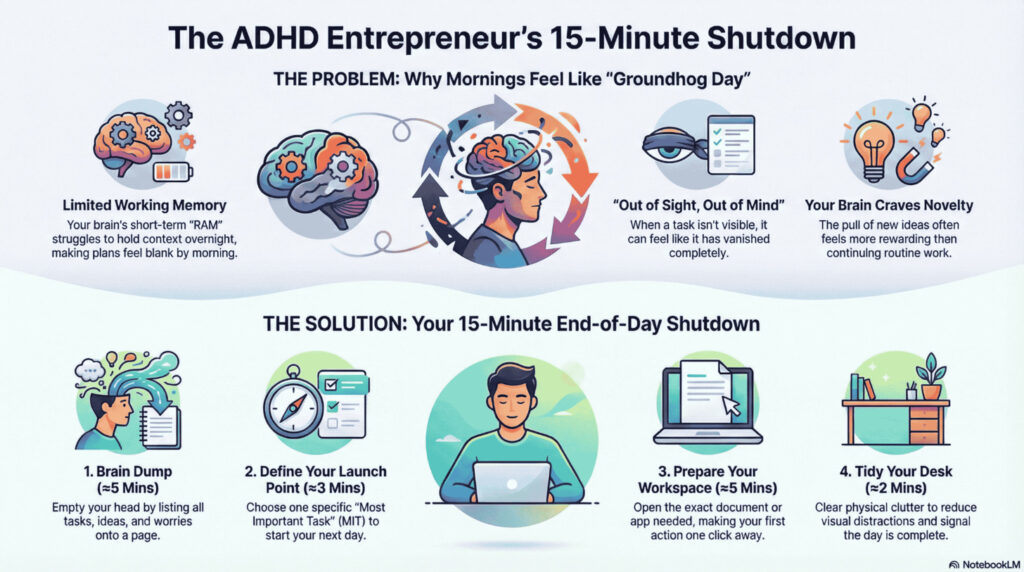
Working Memory Challenges: Many people with adhd experience weaker short-term “RAM” — the mental sticky notes that hold context between sessions. The plan that felt crystal clear at 4 PM can feel blank by 9 AM. Research suggests this pattern is common and shows up as forgotten follow-ups, dropped details, or repeatedly re-opening documents just to remember what you were doing. In practice that can cost the ADHD Entrepreneur time when you switch between client work, proposals, or product tasks.
Object Permanence for Tasks: A useful metaphor: when a task isn’t physically or digitally visible, it can feel like it has vanished. Closing a laptop or clearing your desk can feel like wiping a whiteboard — the context is gone. For business owners that can mean missed client notes, forgotten next steps in onboarding, or needing to rebuild the mental map for a project before you can act.
Dopamine-Seeking and Novelty Preference: The adhd brain often prefers novelty and immediate stimulation; new things register as more rewarding than continuing routine work. That dopamine-driven pull makes it easier to pursue fresh ideas than to return to ongoing tasks, which helps explain why entrepreneurs with adhd sometimes accumulate many half-finished projects instead of finishing a single launch.
- How this shows up in business:
- Client onboarding: you forget the next action and have to reread notes to resume the task.
- Bug triage or product work: reopening tickets is slower because the mental context needs rebuilding.
- Content creation: you stare at a blank document rather than editing because the starting point disappeared.
These mechanisms vary by person and over time, and they don’t require a formal diagnosis to be useful to understand. For readers who want to dig into the science, look for reviews on ADHD and working memory (for example, recent meta-analyses that summarize attention and memory differences) or short, practical books on adhd and productivity that translate research into daily strategies.
SIGN UP FOR YOUR FREE DOWNLOAD AT THE END OF THIS ARTICLE
Breaking the Cycle: The 15-Minute “End-of-Day Shutdown” for ADHD Entrepreneur Productivity.
Stop betting on your future self’s memory. A short, repeatable shutdown ritual creates a clear handoff from today to tomorrow and dramatically reduces the morning friction that eats time and energy. It’s not a magic cure, but investing about 15 minutes at the end of your workday can save many wasted minutes rebuilding context—and help you start the next work day focused on one meaningful task.
Step 1: The Brain Dump. (≈5 minutes) Set a timer and empty your head onto paper or a quick digital note. Include completed items, unfinished tasks, new ideas, and lingering worries—don’t organize yet. Micro-examples: a freelance writer might list “finish client draft, research sources, invoice,” a product designer might jot “finalize hero layout, ask PM about copy,” and a SaaS founder might note “deploy fix, email partner, check analytics.”
The goal is visible information for your tomorrow self; don’t over-edit the list now.
Step 2: Define Tomorrow’s Launch Point (Your MIT). (≈3 minutes) From your brain dump and master list, choose one very specific, actionable MIT (most important task) to start with. Make sure it’s concrete—“Draft intro and outline” beats “work on proposal.” Template sentence to write: “Tomorrow at 9 AM start with: [MIT]. Open: [doc/ticket/contact].” Example: for a solopreneur CEO, write “Call lead X at 9 AM with script on screen.” Keep a single item to avoid decision paralysis in the morning.
Step 3: Prepare Your Workspace. (≈5 minutes) Open the exact document, tab, or app your MIT needs. Pull up the contact in your CRM, queue the research tab, or load the project in your editor. Close unrelated tabs and mute distracting channels. Quick tool tips: add the MIT to a dedicated “Tomorrow” Todoist project or pin the exact Notion page you’ll use. The aim is to make your morning action literally one click away.
Step 4: Tidy Your Physical Desk. (≈2 minutes) Put away loose papers, clear visual clutter, and leave only the few essentials you want to see in the morning (notebook, pen, one printed note). A calm surface reduces visual distractions and signals the brain that the day is complete—helping you return and focus faster.

Micro-shutdown alternatives (when you’re exhausted or on the move):
- If you’re wiped: do a 30–60 second micro-shutdown—write one-line MIT and open one required file or email thread.
- If you’ll be away from your desk: email yourself the MIT with the subject line “Tomorrow: [MIT]” so it’s visible first thing.
- If you only have a minute: write the MIT on a sticky note and place it on your laptop keyboard.
Quick checklist (copy and paste into your note):
- Brain dump — done
- MIT written (specific) — done
- Document/tab open — done
- Desk cleared — done
Try tonight: set a 15-minute timer and follow these steps. Experiment for one week and track the difference in minutes — note how much time you save in the morning versus your usual routine. Small, consistent rituals compound into real productivity improvements for people with adhd who run businesses; these strategies make it easier to convert willpower into predictable progress.
SIGN UP FOR YOUR FREE DOWNLOAD AT THE END OF THIS ARTICLE
Systems Over Willpower: Tools for Your Future Self
| A nightly ritual works best when backed by systems that act like an external brain. These tools reduce the load on attention and memory so your tomorrow self can focus on one task and actually make progress—especially useful for entrepreneurs with adhd who need predictable ways to protect focus and reduce friction. |
Use a “Tomorrow” List: Keep one place—digital or physical—where you put tomorrow’s MIT. Digital option: create a dedicated Todoist project or an Asana list filtered to “Tomorrow.” Paper option: reserve a single notebook page labeled “Tomorrow.” Sample entry (copy/paste): Tomorrow: 9 AM — MIT: [specific task]. Open: [doc/ticket/contact]. Time needed: [minutes]. The benefit: you look at one list, one time, and the decision of what to start is already made.
Leverage Templates and Checklists: For repeatable work, build templates so you never start from scratch. Examples: a sales-call checklist (pre-call notes, script, desired outcome), a proposal template (outline, pricing, next steps), or a sprint checklist for product work. Mini-template for a Quick Start: MIT: _______, Open: _______, 3 things needed: 1) _______, 2) _______, 3) _______. Templates cut decision-making and help you track progress across projects.
Centralize Your Information: Build a single hub—Notion, a well-structured Google Drive, or your project management app—so files, notes, and next steps live in one place. When you ask “Where did I save that?” the answer is always the hub. Tip: create a page for each client or project with a “Quick Start” section listing the MIT and the three things needed to begin.
Choose Digital or Paper Based on What Helps You Focus: Digital tools (Todoist, Asana, Notion) make templates and tracking easy; notebooks reduce friction and can feel more concrete for people with adhd. If you’re unsure, try both for one week and track which reduces morning searching and helps you start the MIT faster. Example workflows:
- Digital workflow: Brain dump → add MIT to “Tomorrow” Todoist project → pin the Notion Quick Start page → schedule a calendar block labeled with MIT.
- Paper workflow: Brain dump in notebook → write one-line MIT on the “Tomorrow” page → stick a physical note on your laptop → leave required printout on desk.
Use Tools to Reduce Friction: Set up simple automations: a Todoist filter for “Tomorrow,” a Notion template for projects, calendar blocks labeled with your MIT, or browser startup pages that open the tabs you prepared. These small tools save time and preserve context so your brain doesn’t have to.
Try body doubling and social supports: Working with another person present (remotely or in the room) can boost attention for many people adhd. Arrange a 25-minute focus session: agree on a start time, share your MIT aloud, work for 25 minutes, then briefly report what you accomplished. Remote etiquette: mute unless speaking, use video if it helps, and share the MIT in chat. Body doubling is a practical, low-cost strategy to reduce distractions and increase accountability.
Ready-made examples and quick templates:
- Tomorrow list entry: 9 AM — MIT: Draft outline for client X. Open: /docs/clientX/outline. Time: 45 minutes.
- Quick Start project page: Project: X | MIT: ______ | Files: link1, link2 | 3 things to start: ______
Further reading and tools to explore: Try a short, practical book on adhd and productivity and an author who writes about systems for creative work—both kinds of reading translate research into actionable skills. For quick research summaries, look for recent reviews on ADHD and working memory or attention (these summarize why external systems help).
Pick one tool to test for a week and track morning recovery time in minutes to see what actually works for you.
From Groundhog Day to Grounded Progress
Stopping the daily rebuild doesn’t require changing who you are—just building systems that work with how your mind and brain operate. When you create a simple handoff from your today self to your tomorrow self, you trade morning chaos for clarity and use your time and energy on meaningful work instead of re-establishing context. That shift is a reliable way to turn small habits into sustained business progress.
Small, consistent strategies—like the 15-minute shutdown, a single “Tomorrow” list, and a central info hub—help entrepreneurs and business owners build real momentum, one actionable step at a time. Make sure you pick one system to try this week: tonight, run the shutdown and set a timer for 15 minutes; tomorrow, track how much less time you spend recovering context. Aim to record the minutes saved each morning so you can compare across days. Follow the downloadable ADHD Entrepreneur Productivity Guide
7-day experiment (copy this template):
- Day 1–7: Run the 15-minute shutdown each evening.
- Morning minutes spent reclaiming context: record the number (e.g., 30, 15, 5).
- Notes: what helped, what distracted, which tool you used.
- End of week: total minutes saved and one decision (keep this system / tweak it / try a new tool).
Want quick resources to read this week? Two accessible books that many readers find practical are Take Charge of Your Life: Practical Paths for ADHD Productivity (look for short, evidence-informed titles in that vein) and a systems-focused author who writes about creative workflow and habit design.
SIGN UP AT THE END OF THIS ARTICLE FOR YOUR FREE DOWNLOAD
Short Research Summary
For a short research summary, search for recent reviews on ADHD and working memory or attention—those pieces explain why external systems and templates reduce cognitive load. If you choose to reference specific books, make sure the author and edition details are correct before linking.
If you’re unsure about diagnosis or support, reach out to others you trust or a clinician—this article offers productivity strategies whether you have a formal diagnosis or are still figuring things out. Consider trusted clinician directories or local support groups as starting points for next steps.
This is practical ADHD Entrepreneur productivity guide for real people: try the ritual, pick one tool to centralize your tasks, and give yourself permission to iterate. Over one week you’ll see whether these ADHD entrepreneur productivity tips actually save you minutes and protect your focus. Small changes compound—one intentional handoff at the end of the day can mean more mornings spent building forward and fewer spent rebuilding.
Mastering the Business World with a Neurodivergent Mind
Managing a startup as an ADHD Entrepreneur, in today’s fast-paced world is a massive undertaking for anyone, but it feels different for us.
Our ADHD brains are often wired for high-intensity sprints rather than the marathon of daily operations.
This isn’t a flaw; it is simply a different way of processing the world around us.
The most important thing you can realize is that your business should serve your brain, not the other way around.
When you try to force a neurotypical schedule onto a neurodivergent mind, you end up failing several times before the day even begins.
By using the 15-minute shutdown, you stop being a victim of your own executive dysfunction.
SIGN UP AT THE END OF THIS ARTICLE FOR YOUR FREE DOWNLOAD
Frequently Asked Questions About ADHD Entrepreneur Productivity
Why do I feel like I’m rebuilding my business every morning? This “Groundhog Day” feeling happens because ADHD brains often struggle with context loading and working memory.
Without a hand-off ritual, your brain has to spend its limited morning energy just figuring out where it left off yesterday.
How many times a day should I check my task list? Checking your list too many times can actually lead to “task paralysis”.
Instead, focus on the “Tomorrow List” created during your shutdown ritual, so you only have one major thing to focus on when you sit down to work.
Is there such a thing as “too much” structure? Yes. In the business world, over-structuring can kill the natural creativity of ADHD entrepreneurs.
The goal is “scaffolding”—enough support to keep you upright, but enough freedom to let your brains do what they do best: innovate. ADHD Entrepreneur Productivity is within your reach.
Read More: The ADHD Hub
UK Government guidance on working for yourself
The NHS overview of ADHD in adults