Tag: Sensory Regulation

  • Coping with ADHD without Medication

    Coping with ADHD without medication can feel like trying to play a video game on “Hard Mode” while everyone else is playing on “Easy.”

    Maybe you are unmedicated by choice, maybe you are waiting (endlessly) for a diagnosis, or maybe the nationwide shortage has left you empty-handed. Whatever the reason, I want you to know one thing: You are not broken.

    You do not need to “fix” yourself. You just need to build a different kind of support system around your brain. Based on the latest research—but translated for real life—here is how to support your neurodivergent mind without the hustle.

    The Non-Medication Toolkit
    🧠 Movement 30 mins of aerobic exercise boosts dopamine & norepinephrine.
    🥑 Fuel Omega-3s, Zinc, & Magnesium are the “engine oil” for focus.
    Anchoring Body Doubling provides “social facilitation” to start tasks.
    ⚙️ Systems Coaching builds future skills; Therapy heals past wounds.

    1. Movement is Your Natural “Reset” Button

    I know, I know. Telling an ADHDer to “just exercise” is annoying. But we aren’t talking about running marathons or getting abs. We are talking about chemistry.

    Research confirms that aerobic exercise—specifically 30 minutes of activity like cycling or dancing—transiently increases cortical inhibition. In plain English? It helps your brain put the brakes on impulsivity.

    The “Anti-Exercise” Strategy:

    • The 5-Minute Dance Party: Put on your favorite song and jump around. It wakes up the brain faster than coffee.
    • Walk and Talk: If you have to make a boring phone call, pace around the room. The movement helps your brain stay engaged.

    2. The “Big Three” Brain Supplements

    While no vitamin can “cure” ADHD, nutritional gaps can make our symptoms so much worse. If your brain is an engine, these supplements are the oil that keeps it from overheating.

    Note: Always chat with your GP before starting new supplements!

    • Omega-3s (Fish Oil): Research suggests that a high ratio of EPA to DHA can help moderate hyperactivity and impulsivity.
    • Zinc: Low zinc levels have been correlated with lower dopamine function.
    • Magnesium: The ultimate “chill pill.” It helps relax the nervous system and is a game-changer for sleep hygiene.

    3. Therapy vs. Coaching: Which One Do You Need?

    If you are coping with ADHD without medication, you might need an external brain to help you organize. But who do you call?

    • Therapy (CBT & DBT): This is for the past & emotions. If you struggle with Rejection Sensitive Dysphoria (RSD), anxiety, or trauma, therapy helps rewire those thoughts.
    • ADHD Coaching: This is for the future & actions. Think of a coach as a “Personal Trainer for Executive Functions.” They help you build systems for the laundry, the emails, and the time-blindness.

    ✨ Free Tool: The Dopamine Menu & Regulation Kit

    Having a bad brain day? Don’t rely on your memory. Download this free one-page “Menu” to stick on your fridge.

    Opens a printable version in a new window

    4. Hack Your Environment: Help at Work for ADHD

    The standard office environment (or WFH setup) is often a sensory nightmare. To get help at work for ADHD, we need to focus on accommodations, not just willpower.

    The “Body Double” Technique

    Have you ever noticed you can clean your room if your best friend is sitting on the bed chatting with you? That’s Body Doubling. It works through “social facilitation”—their presence acts as an anchor, keeping you tethered to the task.

    Try it: Join a virtual coworking space, or just FaceTime a friend and say, “Don’t talk to me, just watch me do these dishes.”

    Externalize Your Memory

    Our working memory is like a leaky bucket. Stop trying to hold it all in your head!

    • The Rule: If it isn’t written down, it doesn’t exist. Use sticky notes, whiteboards, or voice memos.
    • Visual Timers: We have “time blindness” (we have no idea how long 15 minutes is). Visual timers show time disappearing—which creates a little urgency to help us focus.

    5. Be Gentle With Your “Spoons”

    Some days, despite all the water, zinc, and body doubling in the world, your brain just won’t cooperate. That is okay.

    You are navigating a neurotypical world with a neurodivergent brain. On the hard days, drop the guilt. Rest is productive. You are doing the best you can.

    Curious about how your mind works? You can read more about adhd here.

    further reading here

    Inforgraphic depicting coping with adhd without medication
    Coping strategies for ADHD without using Medication

  • Adult ADHD & Autism diagnosis UK 2025

    Navigating Adult ADHD & Autism Diagnosis UK 2025 – Why We Can’t Wait for the System to Fix Itself.”

    Navigating an Adult ADHD & Autism Diagnosis UK 2025 is becoming increasingly difficult as the national waiting list crisis continues to grow

    The Cold Hard Numbers: Adult ADHD & Autism Diagnosis UK 2025. Waitlists, the UK’s neurodevelopmental pathway has officially reached a breaking point. Latest NHS data shows over 700,000 people in England are currently stuck on waiting lists for an ADHD assessment. In some areas, the wait for an initial appointment has ballooned to 145 weeks.

    Adult ADHD & Autism Diagnosis UK 2025 Infographic
    Adult ADHD & Autism Diagnosis UK 2025 Infographic

    The Medication Scandal For those already diagnosed, the nightmare doesn’t end. Shortages of essential medications like Lisdexamfetamine (Elvanse) and Concerta XL have dragged through the entire year. We are being told to “be patient,” while our careers, educations, and mental health crumble.

    Stop Waiting. Start Advocating. We cannot wait for the government to bail us out. We have to create the community we need. Use the tool below to build your Self-Advocacy Passport. Take your results to your GP and demand a referral via Right to Choose—which can reduce your wait from years to months.

    The 2025 UK Diagnosis Crisis

    As of December 2025, over 700,000 people in England are stuck on ADHD waiting lists, with some waiting over 145 weeks. We cannot wait for the system to fix itself. Use this hub to advocate for yourself.

    Self-Advocacy Screening

    This is a tool to help you understand your traits and build evidence for your GP. It is not a clinical diagnosis.

    This is a Call to Arms The Dopamine Hub isn’t just a website; it’s a grassroots movement. I am building this alone, with no tech team and no government funding, because I refuse to watch another year pass where our community is left to suffer because of this crisis.

    I need you. If you have a platform, a voice, or a skill—reach out. If you’ve survived the waitlist and have advice—contribute. We are creating the community we all deserve, because frankly, no one else is going to do it for us.

    PLEASE SHARE THIS RESOURCE TO HELP THE NEURODIVERGENT COMMUNITY ADVCATE FOR THEMSELVES AND EACH OTHER

    Check out our other posts here

    For further reading click here

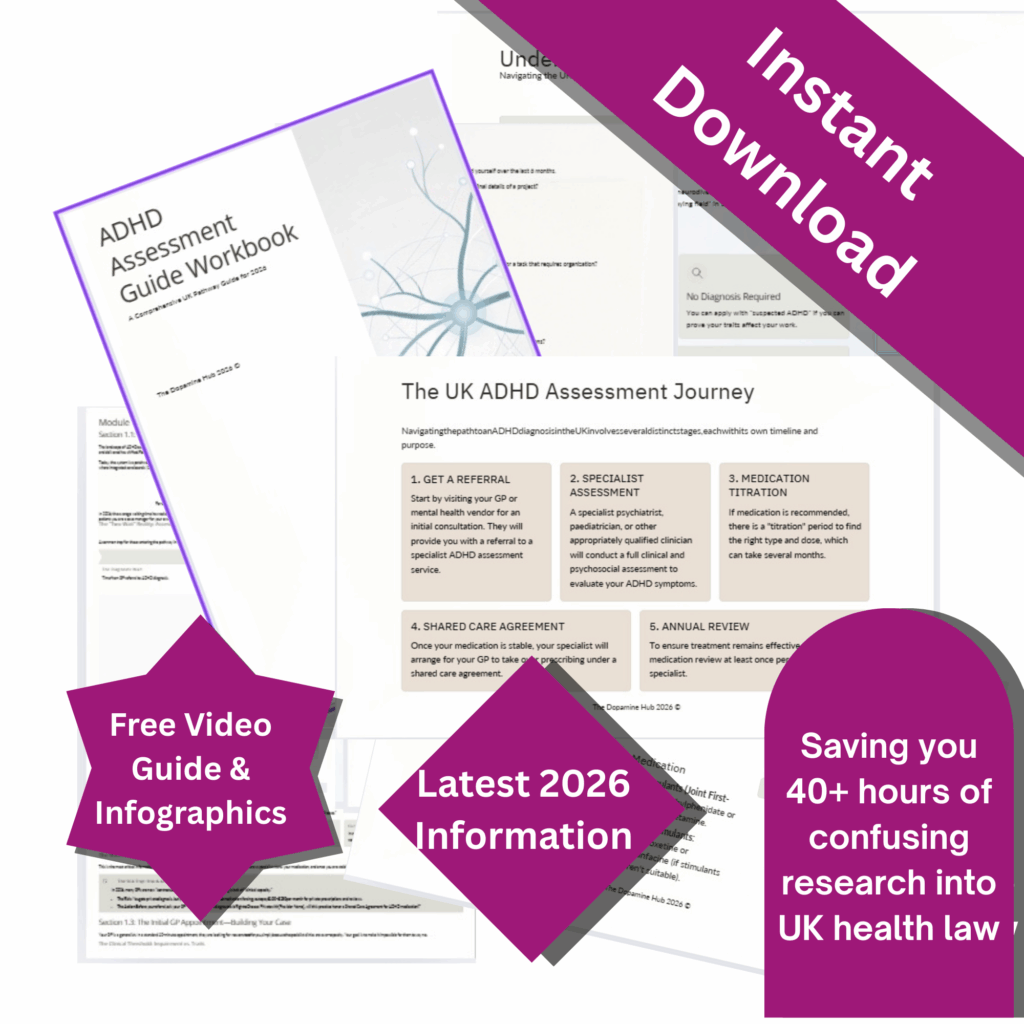
    Buy our 2026 ADHD Assessment Workbook

  • The ADHD Meal Planner That Actually Works: A Guide for Low-Spoon Days

    ADHD meal planner paralysis is real. It is 5:30 PM, you are hungry, and the panic is setting in. The Solution: A Flexible ADHD Meal Planner Bank

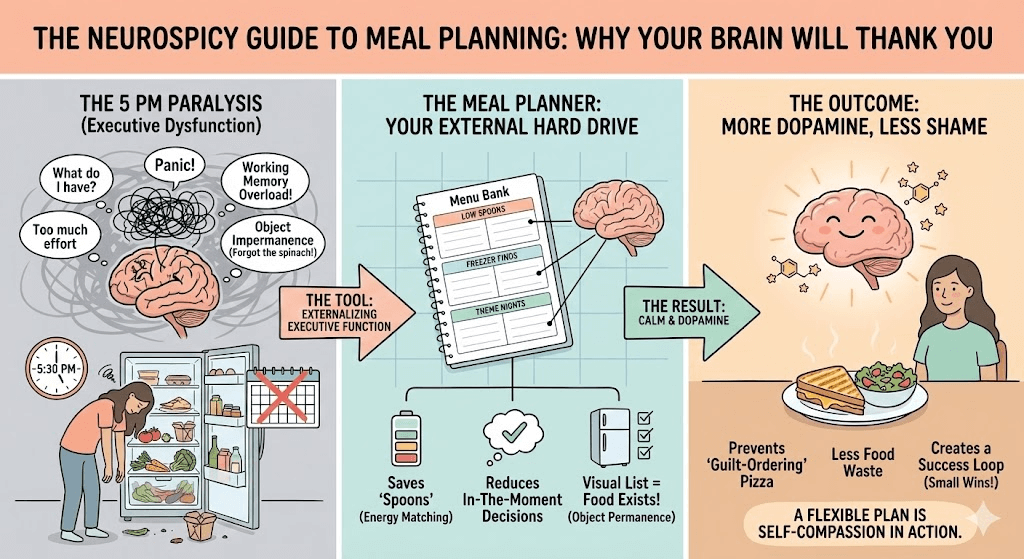
    Infographic titled 'The Neurospicy Guide to Meal Planning' illustrating the cycle of executive dysfunction at 5 PM. It shows how using a flexible ADHD meal planner (acting as an 'external hard drive') saves 'spoons', reduces decision fatigue, and helps with object impermanence, leading to a final outcome of reduced shame and increased dopamine at dinnertime.
    Visualizing the struggle: Why the 5 PM panic happens, and how the right ADHD meal planner acts as an external hard drive for your brain, saving your precious ‘spoons’.

    Why “What’s For Dinner?” Paralyzes Us (And How to Fix It)

    ADHD Meal Planner? It is 5:30 PM. You are hungry. The kids are hungry. You open the fridge, stare at a bag of spinach that is slowly turning into green sludge, and feel a wave of shame wash over you. You order pizza. Again.

    If this sounds familiar, you do not need to try harder—you just need a better ADHD meal planner.

    Standard meal planning advice is designed for neurotypical brains. It relies on working memory and sustained attention, which are often in short supply for us. If you are new to understanding how your brain works, you can read more about ADHD and executive dysfunction on our breakdown page here.

    The Science: Why Your ADHD Meal Planner Needs Flexibility

    It is not laziness; it is biology. Feeding yourself is one of the most complex executive function tasks we do daily.

    • Decision Fatigue: By dinner time, you have made thousands of choices. According to research on executive function, decision-making drains our cognitive battery. Asking “What should I cook?” when your tank is empty is a recipe for paralysis.
    • Object Impermanence: If the ingredients are in the crisper drawer, they might as well be in Narnia. We forget what we own, buy duplicates, and then feel guilty about the waste.
    • The Dopamine Gap: We crave novelty. A rigid “Chicken on Monday” plan feels like a prison sentence to an ADHD brain, so we rebel against our own plan.

    A Realistic ADHD Meal Planner Strategy

    To succeed, we have to stop fighting our brains and start working with them. We need a system that is flexible, visual, and forgiving.

    We call this the “Menu Bank” Method.

    Instead of assigning a specific meal to a specific day (which sets you up to fail if you have low energy that day), you create a list of “safe foods” categorized by how much energy they require.

    Download Your Free 3-Page ADHD Meal Planner Bundle below

    I have created a specific ADHD meal planner tool designed to bypass that 5 PM paralysis. This isn’t just a calendar; it is an executive function support system.

    This Free Bundle Includes:

    • Page 1: The Menu Bank: Categorized by energy levels (0 Spoons vs. Full Spoons).
    • Page 2: The Weekly Grid: A flexible space to map out your week without the pressure.
    • Page 3: The Dopamine Grocery List: Organized by aisle to stop the supermarket zigzag.

    Click the button below to generate your free, printable PDF instantly.

    Includes: Menu Bank, Weekly Schedule & Shopping List
    The Menu Bank
    Fill this once. Use it forever.

    🔋 Low Energy

    0 Spoons Left

    ❄️ Freezer Finds

    Object Permanence Helper

    🎉 Theme Nights

    Decision Fatigue Busters

    The Weekly Layout
    A flexible plan for a flexible brain.
    Monday
    Tuesday
    Wednesday
    Thursday
    Friday
    The Weekend (Loose Plan)
    🧠 Brain Dump / Notes
    Dopamine Grocery List
    Shop by aisle. Stop the zigzag.
    🥦 Produce
    🥫 Pantry
    🥩 Protein / Dairy
    ✨ Novelty / Misc

    How to Use Your New ADHD Meal Planner

    1. Print it out: Keep it visible on your fridge (remember object permanence!).
    2. Fill it out when you have dopamine: Do not try to plan when you are already hungry. Do it when your meds are active or you are feeling motivated.
    3. Laminate it (Optional): If you hate paper waste, laminate the sheets and use a dry-erase marker. This allows you to wipe the slate clean every week—literally and metaphorically.

    Final Thoughts: Fed is Best - Use you ADHD Meal Planner

    Remember, the goal of an ADHD meal planner isn't to become a Michelin-star chef. It is to keep you fed. Whether that's a home-cooked roast or a plate of cheese and crackers, you are doing a great job.

    READ MORE ABBOUT ADHD