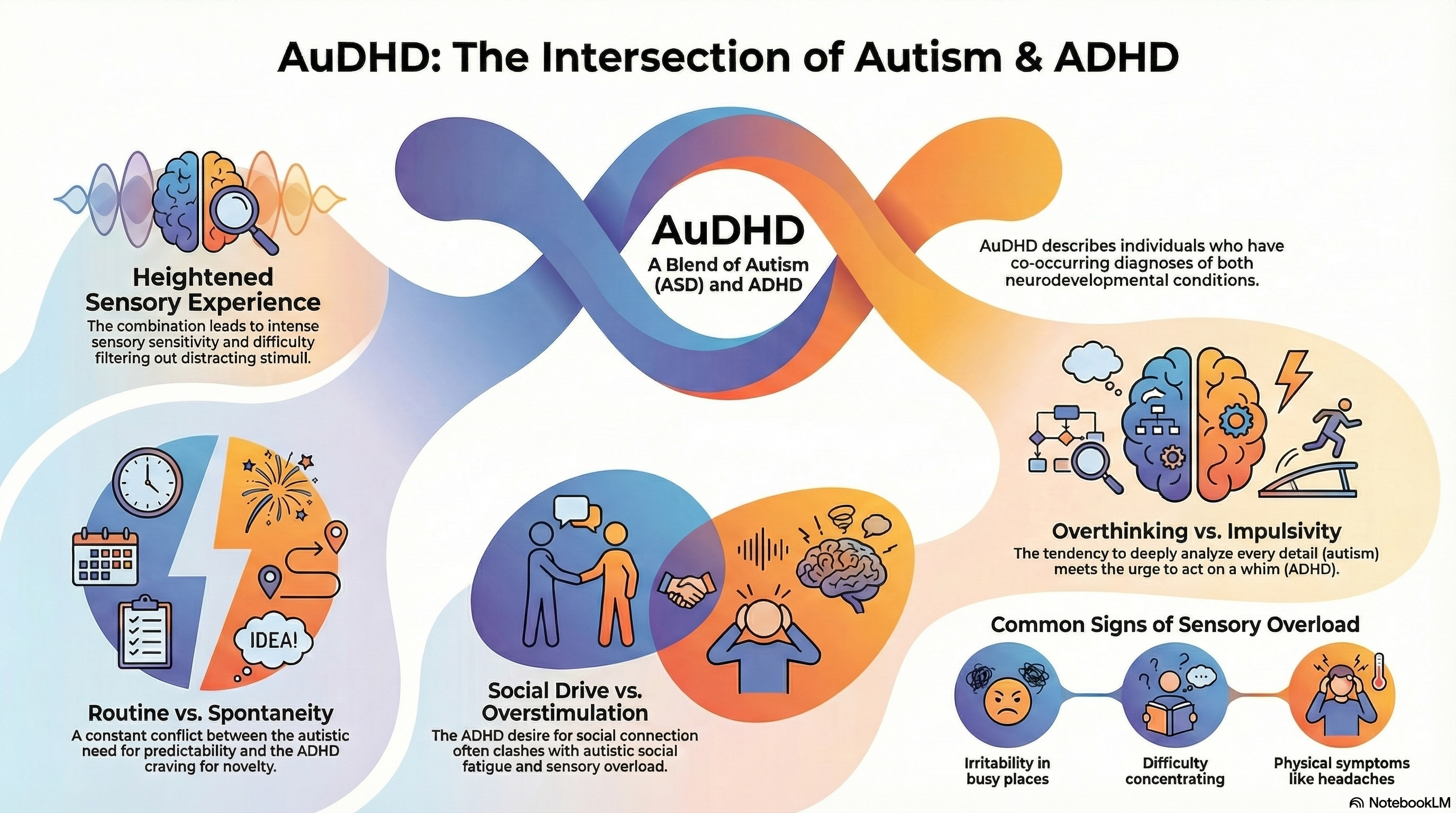
Do you crave a strict routine to feel safe, but feel suffocated the moment you actually stick to one? You might be living in the intersection of Autism and ADHD. These are often the signs of “AuDHD.”
For years, I thought I was just “bad” at being autistic or “bad” at having ADHD. My need for novelty constantly sabotaged my need for order. But I’ve learned that this internal conflict isn’t a flaw—it’s a distinct neurotype.
Before we dive into the science of why you feel this way, take this quick test to see if your brain has these conflicting needs.
If you scored “Likely AuDHD,” you probably experience something called Metabolic Depletion.
The 10 Signs You Might Be AuDHD
If the quiz above felt like I was reading your diary, here is the detailed breakdown of the 10 most common signs of AuDHD. where Autism and ADHD collide.
1. The “Routine Rebellion” Your Autistic side craves a structured routine to feel safe and regulated. But the moment you create that perfect schedule, your ADHD side gets bored and demands novelty, causing you to “rebel” against your own plan.
2. The “Introverted Extrovert” You feel a desperate urge to go out, see friends, and get dopamine (ADHD). But the moment you arrive at the crowded restaurant, you are instantly overstimulated and desperate to go home to your quiet safe space (Autism).
3. The “Exit Seat” Strategy When you enter a new room, cinema, or restaurant, do you automatically scan for the exit or choose the seat closest to the door? This isn’t just a quirk; it is a subconscious safety strategy to ensure you can escape if the sensory input gets too high.
4. The “Hobby Graveyard” You have a cycle of intense hyperfixation on a new interest (buying all the gear, researching for 10 hours straight), followed by a sudden and total loss of interest once the dopamine wears off.
5. “Waiting Mode” Paralysis If you have a doctor’s appointment at 4:00 PM, you cannot do anything productive for the entire day beforehand. Your brain creates a “holding pattern” because transitioning tasks feels too risky.
6. The “Safety Script” You aren’t trying to be “bossy,” but you need to know exactly who is coming, what you are eating, and precisely what time you are leaving. This “scripting” reduces the cognitive load of a chaotic world.
7. Metabolic Depletion (The “Crash”) After a day of masking or socializing, you don’t just feel tired—you feel physically “bruised.” You might need to lie in a dark room for hours to recover. This is your nervous system shutting down to process the backlog of sensory data.
8. Eye Contact Calculator Eye contact doesn’t come naturally. You are often manually calculating it in your head: “Is this too much? Is this too little? Look away now.” It feels like a performance rather than a connection.
9. Hyper-Vigilance to Background Noise You can hear the electricity buzzing, the clock ticking, or a conversation three tables away. Your brain lacks the “filter” to tune out irrelevant sensory input, leading to faster burnout.
10. Justice Sensitivity You feel a physical, visceral rage when you witness unfairness or injustice, even if it has nothing to do with you. You cannot “just let it go” because your brain perceives it as a violation of order.
We often judge ourselves as “lazy” because we need to lie in a dark room after a social event. But the reality is that our brains are processing double the data. We have the ADHD inability to filter out noise colliding with the Autistic intensity of sensory input.
The “Control” Myth Do you need to know exactly what time a party ends or what is on the menu before you go? People might call you “controlling,” but this is actually a Safety Script. When the world feels unpredictable and loud, our brains try to script the future to reduce the threat level.
If you walk into a room and immediately sit near the door, that isn’t antisocial. It’s a survival mechanism. Knowing you have an “escape route” lowers your baseline anxiety, allowing you to actually be present and enjoy yourself.
The key to thriving with AuDHD isn’t to force yourself to be “normal”—it’s to protect your energy.