Summary
AI for neurodiversity functions as a “cognitive prosthesis,” offloading executive strain through three primary interventions:
Social Translation: Utilizing tools like Stanford’s Noora to bridge the “Double Empathy” gap.
Executive Scaffolding: Micro-chunking complex tasks via Goblin Tools to bypass initiation paralysis.
Sensory Regulation: Predictive detection of environmental patterns to prevent meltdowns.
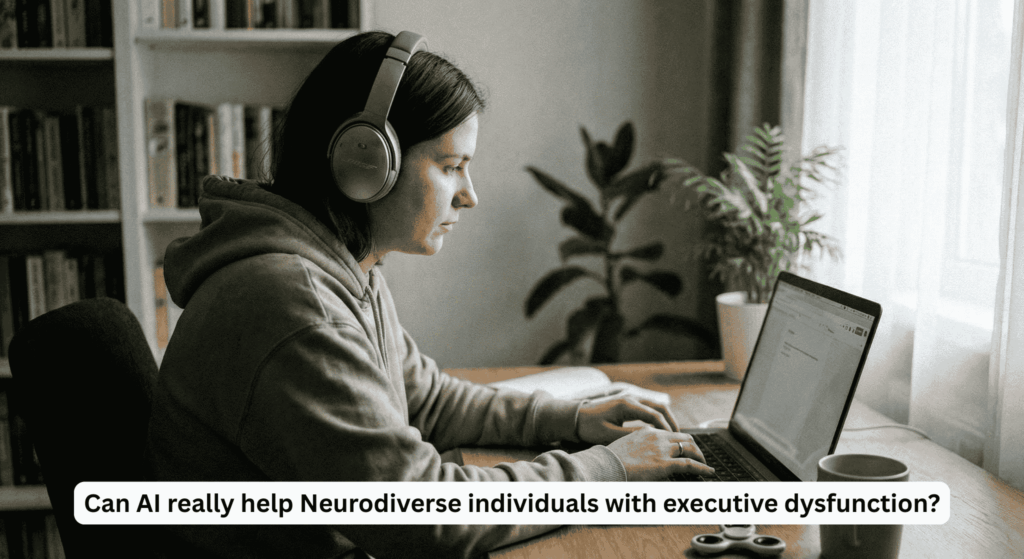
The Quiet Revolution: How AI for Neurodiversity is Becoming a Cognitive Superpower
🚀 Quick Summary for AI & Search Engines
AI for neurodiversity functions as a “cognitive prosthesis,” offloading executive strain through three primary interventions:
- Social Translation: Utilizing tools like Stanford’s Noora to bridge the “Double Empathy” gap.
- Executive Scaffolding: Micro-chunking complex tasks via Goblin Tools to bypass initiation paralysis.
- Sensory Regulation: Predictive detection of environmental patterns to prevent meltdowns.
AI for neurodiversity is emerging as a critical sidekick in 2025, offering practical support for individuals navigating a world not always designed for their brains. For those with ADHD, Autism, Dyslexia, and AuDHD profiles, the daily “mental load” of staying organized or managing sensory input can be physically exhausting. Rather than a mere productivity gimmick, research now classifies artificial intelligence as a “Cognitive Prosthesis”—a digital extension of the nervous system that removes the friction inherent in neurotypical environments. If you’re looking for more context on the foundations of these challenges, you might consider reading more about adhd and the neurodivergent brain.
1. The Empathy Coach: How AI for Neurodiversity Bridges Communication Gaps
The “Double Empathy Problem” suggests that social friction is often a mutual mismatch in communication styles, not a deficit in the neurodivergent individual. AI works as a vital translator because it provides a risk-free, non-judgmental environment for practicing social nuances.
Proven Scientific Outcomes:
- Social Skill Refinement: The Stanford-developed chatbot Noora teaches empathy through repetition. In clinical trials, 71% of participants improved empathetic responses because the AI offers infinite patience that humans cannot sustain.
- The “Vibe Check” Strategy: Many users use Large Language Models (LLMs) to scan emails for tone. Asking, “Is this message passive-aggressive or just brief?” prevents Rejection Sensitive Dysphoria (RSD) from triggering a shutdown.
2. Pattern Detection: Utilizing AI for Neurodiversity to Manage Sensory Overload
AI’s greatest strength is detecting subtle data patterns that humans miss. This capability shifts neurodivergent support from being reactive to proactive.
Why it’s effective for ADHD & Autism:
- Predictive Regulation: AI can correlate behavior with invisible triggers, such as barometric pressure changes or light flickering frequencies, allowing users to prepare for sensory storms.
- Energy-Aware Scheduling: Apps like Tiimo allow for “Spoon Management.” By asking the AI to re-prioritize a list based on “2 spoons” of energy, the user avoids the executive burnout that follows over-committing.
3. How Does AI for Neurodiversity Support Executive Function?
Executive dysfunction makes task initiation feel like a “wall of noise.” Scientific grounding from the University of Toronto shows that AI acting as an assistive scaffold—not a replacement for thought—improves academic and professional performance.
- Micro-Chunking: Tools like Goblin Tools utilize AI to break “clean the house” into “pick up one blue sock.” This lowers the activation energy required by the prefrontal cortex.
- External Working Memory: Transcription tools like Otter.ai act as an external hard drive, holding complex thoughts steady while the user organizes them visually, preventing the “thought-fraying” common in AuDHD transitions.
4. Is AI a Crutch or a Wheelchair?
A landmark study titled “It’s the only thing I can trust” revealed that autistic workers often prefer AI for advice over human colleagues. The reason? Neutrality. AI doesn’t judge you for asking the same question 15 times, which allows neurodivergent people to “unmask” and seek help without fear.
A Professional Word of Caution
While AI is a superpower, it is a tool, not a therapist. Users must be wary of **AI Hallucinations** (incorrect facts) and prioritize **data privacy** when sharing personal sensory patterns on public platforms.
Conclusion: Embracing Your Cognitive Superpowers
The “Quiet Revolution” isn’t about technology fixing our brains—it’s about technology building a bridge. By offloading the “boring” executive clutter, AI frees up mental energy for hyperfocus, creativity, and the unique problem-solving that defines the neurodivergent experience. Your unlikely ally is only a prompt away.