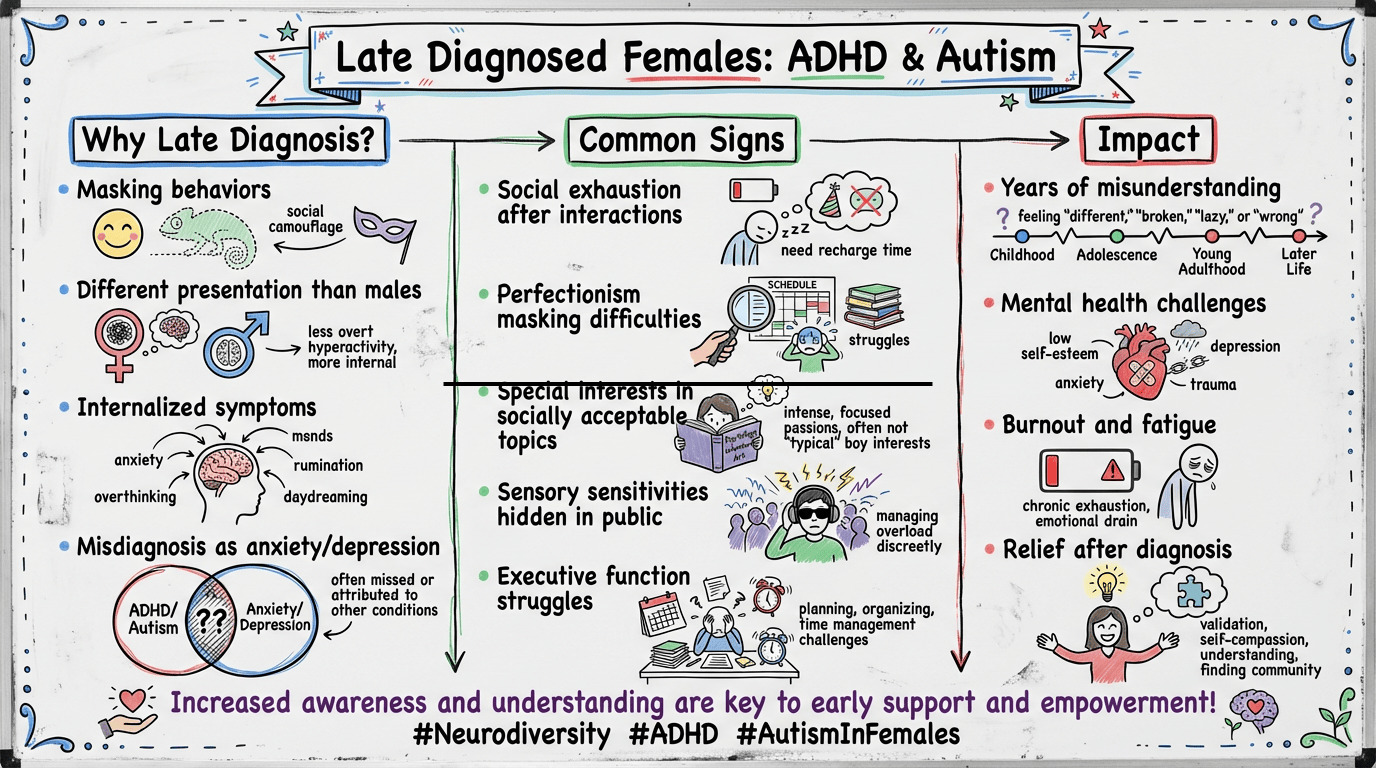
Summary
Quick Read: The Late Diagnosed Females Guide
If you are experiencing sensory overwhelm or have limited “brain fuel” today, here are the essential takeaways from this article:
The “Hysteria 2.0” Reality: Throughout history, women’s neurological differences have been dismissed as “hysteria” or “attention-seeking.” Today, this persists as medical gaslighting when women are told they are “swinging the lead” or “over-pathologising” their struggles.
The Biological Collision: Your “mask” didn’t break because you are failing; it broke because Estrogen supports Dopamine. As hormones shift (especially during perimenopause), the biological fuel required to hide your traits physically runs out.
Physical Receipts: Neurodivergence is a whole-body experience. High rates of Hypermobility (hEDS), chronic pain, and PMDD in women are physical indicators of a differently wired nervous system.
The “Good Girl” Trap: Because diagnostic criteria were based on boys, “quiet” or “compliant” autistic traits in girls are often missed, leading to a lifetime of exhausting masking.
Immediate Next Steps:
Start a 2-Week Diary: Document sensory triggers, masking incidents, and the physical cost (fatigue/pain). Use this as your “evidence” for GP appointments.
Request a Referral: Use the script: “I have long-running difficulties with sensory sensitivity and social exhaustion that have worsened recently; I would like a referral for an adult neurodevelopmental assessment.”
Join the Club: You are not alone. Transitioning from “masking” to “being” is an act of resistance.
Late Diagnosed Females
This guide is authored by the founder of The Dopamine Hub, drawing on both personal lived experience as a late diagnosed female and an extensive synthesis of clinical research regarding the estrogen-dopamine collision. By intersecting the historical context of ‘Hysteria’ with modern medical data on hypermobility (hEDS) and neurodivergent burnout, we provide a unique, evidence-based perspective that bridges the gap between patient advocacy and neurodevelopmental science. Our mission is to provide neurodivergent empowerment through high-utility tools like the Dopamine Menu, ensuring that the spiky profile of autism in women is recognized not as a ‘trend,’ but as a biological reality supported by systemic clinical reviews and community-validated survival strategies
For centuries, medical and psychiatric practice has done more than overlook women — it often turned survival and difference into a diagnosis. Women who spoke about pain, sensory difference or distress were routinely minimised or relabelled instead of being heard, and that pattern still shapes clinical thinking and public debate today.
The recent UK government review into rising ADHD and autism diagnoses has become a flashpoint within that longer history of describing female behaviour as “less than”, “unreliable” or “manipulative”. When Health Secretary Wes Streeting warned of a possible “medicalisation of normal life”, that phrasing echoes older ways of dismissing women’s experiences rather than engaging with them — and it can have concrete consequences for autism diagnosis, access to care and ongoing health.
If that makes you angry, you are not overreacting. This is, in many ways, Hysteria 2.0: a modern reprise of historical dismissals that stretch from witch‑hunts to the asylum era, reframed in clinical language. The stakes are not just rhetorical — they affect mental health, everyday wellbeing and whether girls and women get timely support and appropriate autism diagnosis.
There is also a growing community who call themselves Late Diagnosed Females — people who, often after years of masking or being misread, finally get language for what they have experienced. This article outlines the historical context, explains how social expectations and biology can delay recognition, and offers practical steps and resources for anyone who sees themselves here.
If you are reading this and it feels familiar, you are not alone. Many women and girls have had similar experiences, and emerging research and peer support are changing how clinicians and communities respond. Read on for concise history, evidence-based explanation and clear next steps to help with assessment, access to support and better self‑care.
A Legacy of Flames and Asylums: This Isn’t New
The pattern of dismissing women’s neurological and physical reality recurs whenever women begin to tell their own stories. These are not isolated incidents but part of a broader history in which female experience has been minimised, medicalised or criminalised — a backdrop that still affects how autism is recognised today.
- The Witch Trials: Centuries before modern psychiatry, women who practised traditional remedies, challenged local authority or lived outside expected gender roles were accused of witchcraft and, in many cases, executed. Historians note these trials frequently targeted people with specialist knowledge of bodies and care — the very skills that emerging medical professions later reframed and co‑opted.
- The Asylum Era: In the 19th and early 20th centuries, women were institutionalised under broad labels such as “moral insanity” or “hysteria.” Reasons for commitment ranged from non‑conformity to childbirth outside marriage; the result was often the same — dissenting bodies and minds were locked away rather than listened to or treated with nuance.
- The Hysteria Label: The word hysteria derives from the Greek hystera, meaning “womb.” For decades many female complaints were attributed to a “wandering uterus.” Today the language has shifted to terms such as “over‑pathologising” or “medicalisation of normal life”, but the practical effect can still be similar: important symptoms dismissed as personality, defect or exaggeration rather than investigated as health issues.
That history matters because patterns persist in present clinical practice. Diagnostic criteria for neurodevelopmental conditions were largely developed from research samples dominated by boys and men, so the case examples clinicians learn from textbooks and training often reflect male behaviours and presentations.
As a result, autism and related conditions on the autism spectrum can look different in girls. Quieter coping strategies, socially compliant behaviour and internalised distress are easily read as personality, good manners or anxiety rather than as signs someone might benefit from assessment. This mismatch between diagnostic criteria and lived presentation helps explain why many girls and women have been missed, mislabelled or only diagnosed after years of struggling.
Concrete parallels make this clear. Just as midwives and herbalists were once sidelined as “superstition” despite practical knowledge of bodies, modern clinicians have sometimes overlooked signals that do not match prevailing, male‑focused case studies. A practical effect is that referral thresholds — the point at which a child or adult is sent for assessment — have often been calibrated to more externalising behaviours that are commoner in boys, which biases recognition and referral pathways.
Quick takeaways:
- Diagnostic training has historically emphasised externalising behaviours, which can bias referrals and recognition.
- Quiet or compliant presentations in girls may be interpreted as shyness or anxiety rather than as autistic traits.
- This mismatch contributes to missed diagnosis and delayed support, with consequences for mental health and daily functioning.
Have you ever been told you were “too quiet” to be considered for assessment, or that your difficulties were just “shyness” or “anxiety”? If so, that experience fits a long pattern of dismissal. Later sections provide evidence summaries, short anonymised case examples and clear next steps — including how to document behaviours and situations that standard checklists may miss, and where to find clinicians and peer groups with experience of girls’ and women’s presentations.
Late Diagnosed Females & The “Good Girl” Double Standard
Clinical descriptions of neurodivergence were largely formed from samples dominated by boys, so the “typical” picture of autism and ADHD came to reflect louder, more outward behaviours. Quiet, compliant presentations and internal struggle have therefore been less likely to be recognised in girls.
- The Male Experience: A conspicuously hyperactive or disruptive boy is readily framed as a clinical problem; externalising behaviours interrupt classrooms and prompt referrals more quickly.
- The Female Experience: Girls are often socialised to be the “good girl” — quiet, attentive and helpful. Those expectations encourage camouflage: behaviours that look like coping or diligence are frequently read as personality rather than as possible signs of autism or ADHD.
What masking looks like in everyday life for Late Diagnosed Females
Masking. This camouflage has a name. Masking is the conscious or unconscious suppression of autistic traits to mimic neurotypical behaviour and fit in. For many autistic girls and women, masking is a survival strategy — learning social scripts, forcing eye contact, rehearsing responses — but it carries a cost.
Short examples: masking can mean copying others’ facial expressions, suppressing stimming, or memorising small talk. It can look like staying late to finish social niceties, practising greetings in the mirror, or mentally scripting a reply to avoid being caught off‑guard.
School (composite vignette): a bright schoolgirl who studies hard, helps classmates and never acts out. Behind the scenes she struggles with sensory overload, executive difficulties and exhaustion. Teachers praise her diligence; no referral is made.
Adulthood (composite vignette): a woman in her thirties who learned to mask through adolescence finds herself burned out in a demanding job. She has trouble organising daily tasks and experiences chronic anxiety, but her outward behaviour hides these difficulties from colleagues and clinicians for years.
Parent perspective (composite vignette): a parent notices their daughter is extremely compliant at school but meltdowns occur at home. Professionals call her well‑behaved; the parent worries that her internal distress is being overlooked.
Evidence and consequences: some studies find sustained masking is associated with poorer mental health outcomes. Research and reviews report links between prolonged masking and higher rates of anxiety and depression, and between masking and later or missed diagnosis for autistic girls and autistic women — though prevalence and the strength of association vary between community and clinic samples, so qualifying language is important.
How masking leads to missed diagnosis: because standard referral checklists and clinical examples often emphasise externalising behaviours, internalising presentations are less likely to trigger assessment. Teachers and GPs may interpret quietness as compliance, and others may miss sensory or executive difficulties that occur out of sight.
Small steps you can take now
Keeping a short, structured record of everyday difficulties makes a big difference in brief GP or school appointments. A focused diary helps capture masking, sensory triggers and the practical consequences that are often invisible in a five‑ or ten‑minute consultation.
- How long? Aim for 2–4 weeks of notes — enough to show a pattern without becoming overwhelming.
- Diary template (printable): date / time / setting / what happened (behaviour) / sensory triggers / how you felt (internal experience) / practical impact (missed work, exhaustion, meltdown).
- Record masking: note what you said or did to appear “normal” and what you felt inside (for example: smiled and made eye contact, but experienced panic and exhaustion afterwards).
- Note physical costs: fatigue, pain, panic attacks or sensory overload episodes and how long recovery took.
- Bring corroboration where possible: if a trusted person (family member, partner, teacher) can attend or provide a short statement, that can help clinicians see patterns you find hard to describe. Ensure you have consent and agree what will be shared.
Practical CTAs: print the diary template before you start; bring one or two concrete diary entries to your GP or school meeting; and email a brief summary to any clinician ahead of an appointment if the practice accepts attachments — this saves time in short consultations.
If this rings true, you are not alone. Many autistic girls and autistic women report years of masking before getting recognition, and documenting concrete examples improves the chance of a useful referral rather than a dismissal. Later in this article we signpost peer groups, assessment pathways and clinicians experienced in masked presentations so you can find tailored support that matches your abilities and needs.
The Biological Receipts: You Can’t Gaslight a Nervous System
The sceptics ask: “If you managed for 40 years, why can’t you manage now?” The short answer is that biology and life circumstances change across the life course — and those changes can make long‑running coping strategies collapse. Life events, cumulative stress and hormonal shifts can reveal difficulties that were previously compensated for. Below are the main biological and health factors to consider, written with cautious phrasing and signposts to evidence you can follow up on.
1. The oestrogen–dopamine interaction – one of many expalnations for the Late Diagnosis of Females
Oestrogen modulates dopaminergic systems in the brain and that interaction supports attention, motivation and executive function for many people. In practical terms, reproductive‑age oestrogen levels can buffer or mask some cognitive differences; when oestrogen falls during perimenopause and menopause, many women report changes in concentration, energy and cognitive control.
Some clinicians and researchers suggest these hormonal shifts can produce a biological “unmasking” — longstanding autistic traits or attention difficulties become more apparent because earlier compensations stop working. This does not mean hormones cause autism or ADHD; rather, hormonal changes may alter how underlying traits present in daily life.
Practical tip: if you notice a clear change in concentration, irritability or tolerance for sensory input in midlife, note the timing and mention it to your clinician — it is useful contextual information for assessment and management.
2. The physical cost of decades of masking
Sustained masking — continually suppressing natural responses and forcing neurotypical social behaviour — is associated with chronic stress. Over years, that burden of coping can contribute to poorer mental health and increased somatic symptoms.
Some studies find higher rates of anxiety and depression among many autistic people who mask extensively. Clinic samples have also reported elevated rates of other conditions in referred adults — for example, hypermobility spectrum disorders (Ehlers–Danlos syndromes / HSD), chronic pain and certain autoimmune diagnoses — but these figures vary between community and clinical samples and are influenced by referral bias.
Important caveat: prevalence estimates from specialist clinics reflect who is referred there and so should not be presented as general‑population rates. Use qualifying phrases such as “some studies find” or “clinic samples report” when describing these associations; a balanced article should signpost primary reviews and cohort studies for readers who want the evidence.
Clinical vignette (composite): a woman in her forties who masked socially for decades now experiences chronic fatigue, widespread pain and panic attacks. Her GP treats anxiety; it is only when a specialist recognises a pattern of sensory intolerance and social exhaustion that a broader neurodevelopmental assessment is considered. (This vignette is composite and anonymised.)
3. Specific intersections: PMDD, pain and sensitivity to fluctuation
Some research indicates that premenstrual dysphoric disorder (PMDD) and other hormonally linked conditions appear more often in clinic samples of autistic and ADHD women. Sensitivity to hormonal fluctuation — which can affect mood, sleep and cognition — appears important for a subset of autistic women and may help explain why symptoms shift at particular ages or life stages.
Again, avoid blanket statements: it is not accurate to say PMDD or pain conditions affect “nearly all” autistic or ADHD women. The safer phrasing is that some studies demonstrate increased sensitivity to hormonal change in many autistic and ADHD women, and clinicians are increasingly attentive to these intersections when planning assessment and support.
4. What this means for diagnosis and support – The Personal Cost of being an undiagnosed female
These biological and somatic factors do not cause autism or ADHD; they interact with lifelong traits and social demands to influence when and how difficulties become clinically apparent. For some adults, accumulated stress, changing hormones and life transitions produce a tipping point where masking is no longer sustainable and autistic traits or attention differences begin to disrupt daily functioning.
Reasonable next steps include: talking to your GP about referral to a specialist adult neurodevelopmental service (check local NHS pathways), seeking clinicians with experience of adult and female presentations, and exploring multidisciplinary support such as psychological therapy for mental‑health needs, occupational therapy for sensory and executive challenges, and specialist input for hormonal or pain conditions.
Assessment and appointment checklist
Concrete evidence helps in short appointments. Keep a brief diary (2–4 weeks) of cognitive lapses, sensory triggers, mood variation across your cycle (if relevant) and examples of masking. Bring concrete examples to the GP: dates, impact on work or relationships, prior assessments and any relevant medical history. Example phrasing for a GP appointment: “I’ve had long‑running difficulties with organisation, sensory sensitivity and social exhaustion that have worsened recently — could I have a referral for an adult neurodevelopmental assessment?”
- Diary template: date / time / setting / what happened / sensory triggers / how it affected you (work, relationships, sleep).
- List concrete examples of tasks that feel difficult (planning, time management, sensory overload incidents).
- Note co‑occurring issues (pain, menstrual changes, autoimmune diagnoses) and dates of onset.
5. Evidence, sources and editorial cautions
When referring to research, use balanced citations: look for recent reviews on sex differences in autism or ADHD, menopause‑and‑cognition reviews, and epidemiological work on co‑occurring conditions in clinical cohorts. Use qualifying phrases such as “some studies find” and “elevated rates have been observed” rather than absolute prevalence claims. Editorial teams should insert 2–3 key references (systematic reviews and major cohort studies) to support the points above.
If you are currently struggling with marked changes in cognition, mood or physical health, or if longstanding masking is causing burnout, seek clinical advice promptly. Support options include psychological therapy with clinicians experienced in autism, occupational therapy for sensory and executive needs, and specialist gynaecological assessment where hormonal issues are suspected.
Join the Club. Wear Your Weird.
The Late Diagnosed Females Club is less a formal organisation than a name for a growing community of women and girls who finally have language for what they’ve experienced — and who are done apologising for their needs. It is a space of mutual recognition where practical advice and emotional validation meet.
For many autistic, ADHD & AuDHD women and late‑diagnosed girls, membership feels like resistance: a refusal to accept that masking, exhaustion or sensory difference should be erased or dismissed. That collective pushback reframes the old charge of “hysteria” as a history of misrecognition rather than a personal failing.
We are the descendants of those labelled “hysterical” or “troublesome.” That history matters, but so do practical steps. If this resonates, here are three immediate, evidence‑informed ways forward and a short checklist you can use today.
- Seek assessment or a referral. Ask your GP about adult neurodevelopmental assessment or local diagnostic services. If you’re young and in school, request an educational psychology referral or an assessment through your school — explain that girls’ presentations can differ from typical textbook examples. Short scripts you can use: adult — “I’ve had long‑running difficulties with organisation, sensory sensitivity and social exhaustion that have worsened recently; could I have a referral for an adult neurodevelopmental assessment?” / young person/parent — “My child is frequently quiet at school but has meltdowns at home; can we arrange educational psychology input or screening for autism/ADHD?”
- Find peer support. Look for moderated online groups or local meetups for autistic women, parents of autistic girls or those describing themselves as Late Diagnosed Females. Peer groups and moderated forums offer practical recommendations, clinician suggestions and emotional support — check whether groups have safeguarding rules and moderation before joining.
- Build a multidisciplinary support plan. Combine mental‑health input for anxiety or depression, occupational therapy for sensory and executive challenges, and gynaecological review if hormonal issues such as PMDD may be involved. A joined‑up plan improves functioning and reduces the pressure to mask.
Note: late diagnosis is not unique to women — people of all genders can be missed by initial assessments — but many women and girls report years of masking before recognition. If you identify with this article, these are practical ways to start getting the support you need.
Practical strategies for everyday life
Quick, manageable steps can help you get support now and make daily life more sustainable:
- Keep a two‑week diary: record times you had to mask, sensory triggers and any mood or cognitive changes across your cycle (if relevant). Use the diary template suggested earlier when you meet a GP or employer.
- Document concrete impacts: note how difficulties affect work, study or relationships — missed deadlines, lost concentration, exhaustion or meltdown episodes — because specific examples make adjustments and referrals more likely.
- Ask for reasonable adjustments: speak to your employer or school about simple measures such as a quiet space, written instructions, flexible deadlines or reduced sensory load. Provide brief documentation from your GP where appropriate.
- Small routines that help: prioritise sustainable self‑care (regular sleep, sensory breaks, pacing) and trial occupational‑therapy strategies for executive‑function support.
Resources and community groups
Useful starting points include NHS pages on autism diagnosis and support, national charities that focus on autistic girls and women, and specialist adult clinics. When you contact services, mention masked behaviours and atypical presentations explicitly — clinicians can miss autistic traits because girls and women often present differently on the autism spectrum.
Examples to add when publishing (local links recommended): NHS guidance on autism diagnosis; charities specialising in autistic girls and autistic women; moderated online peer groups for late‑diagnosed people where members share clinician recommendations and lived experiences.
Remember: a diagnosis is not an excuse; it is information that can unlock tailored support for health, relationships and daily life. Many personal accounts and some studies report relief and improved mental health after diagnosis because people can stop expending energy on masking and start building strategies that suit their strengths and abilities.
We are done apologising — but we are not done with action. Share your experiences, seek trusted clinical advice, and connect with others. Wear your “weird” as a signpost to better care for girls, women and all the people who have been missed.
If you think you might be a Late Diagnosed Female, start by asking your GP about referral pathways and local support services — there are ways forward and you do not have to go it alone. If you are in immediate crisis or having thoughts of harming yourself, contact NHS 111 or Samaritans in the UK (116 123) or your local emergency services right away.
Testimonials (anonymised):
“Receiving a diagnosis in my forties finally explained years of exhaustion — it didn’t change who I am, but it changed how I get help.”